 |
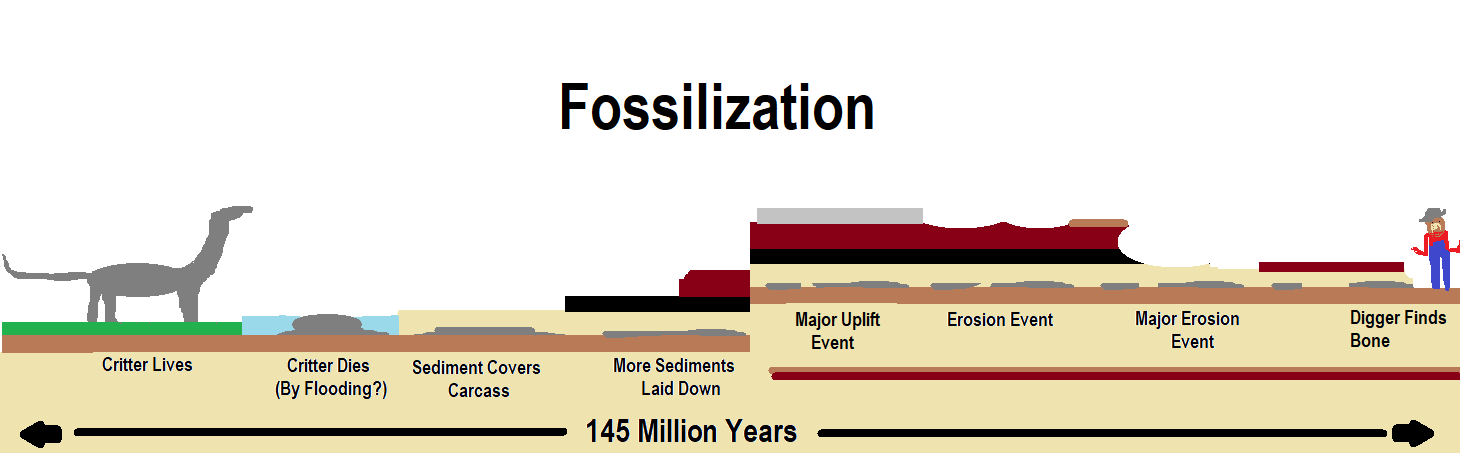
The above illustration shows how fossilization works over time following the death of a critter. It's first important to realize that not every critter will be fossilized. In fact, the great majority will not be. There are lots of hungry predators and scavengers out there. Most dead creatures will be eaten and/or decompose, leaving nothing more than a scrap of bone (if that). Any bones that do remain will be crushed, scattered and lost to time. Even where the dead creature has not been completely devoured, its remains will most likely be destroyed by some other means: fire, volcanic eruption, subduction, and any of millions of combinations of circumstances over time that can destroy bone which, whether or not fossilized, is really quite fragile. Within air it can actually crumble into dust as any Egyptologist dealing with mummies can attest.
That given, what causes a critter's remains to be fossilized? The first requirement is a quick burial -- for the quality of the specimen, the sooner the better. Landslides, flooding and natural critter traps (like the La Brea Tar Pits) provide the best chance for covering the critter and, depending on the dryness and fineness of the soil, can also allow for mummification or the preservation of skin impressions. Once covered, the critter's flesh decomposes and the actual fossilization process can begin.
Fossilization is normally defined as the process whereby mineralized water, leaching through wood, bone, teeth or shell, replaces the organic material, turning it into stone. Oddly enough, this can take place within a very short time, but normally takes centuries or millenia. Also, more colloquially, fossilization refers to natural castings where a footprint or a thoroughly decomposed body part leaves a void to be filled by other material thus preserving the ancient impression.
Throughout the fossilization process and after it, the fossil remains subject to all of the environmental changes surrounding it, and we're not discussing anything so insignificant as temporal climate change. We're discussing Deep Time here: the movement of continents as they come together and pull apart, opening oceans and closing them, raising mountains and wearing them away, lifting ocean floors to the tops of the highest peaks. It's why we find pleisiosaurs in the middle of Wyoming and seashells on the top of Mount Everest. It why entire ecosystems are forever lost to us where the continents or oceans on and in which life once thrived have since been subducted during the endless dance we simply call tectonics.
Then there's also the constant layering of the Earth's surface, in the water and out of it. Millions upon billions of tiny crustraceans die to create a limestone layer on which first rest and then are covered the bones of other critters, large and small. On land, a sandstorm or a flooding event cover what was there before. In either environment, a landslide or a volcanic eruption can create another layer, and so it goes. The critters that are buried beneath these layers may never be exposed or may appear to be eroded away again. A succession of local earthquakes may separate and/or destroy fossilized body parts leaving, in the end, a single bone that might be someday be used to describe an entire genus...or even a family...or, more likely, be lost in the clutter.
So, do be advised, fossilization of any critter's bones is rare. And, sadly, its preservation is even more rare. If fossilized bone is exposed to air (usually the only way any paleontologist is going to discover it) it quickly begins to erode on the surface. Any large fossil field is littered with hunks of decayed fossilized bone which quickly fall apart and disappear. Indeed, it's often the chunks of these bones that separate and fall that serve as a path to what remains of the critter if the prospecting digger is both knowledgeable and lucky.
|
|
|
|